

.jpg)
In our latest webinar with Dennis Goedheid (CEO and founder of Casiola), Richard Vaughton (CEO and founder of Yes Consulting) and Bart-Jan, one theme became impossible to ignore: revenue management in short-term rentals is no longer primarily about pricing. It is about visibility, booking probability, and operational quality at scale. This blog expands on those ideas.
Watch the full recording here.
Pricing is no longer your competitive edge
There was a time when adopting dynamic pricing was enough to outperform the market. Early adopters saw clear uplift compared to manual rate setting. Today, that advantage has largely disappeared.
Most professional operators now use some form of automated pricing tool. That means the baseline intelligence around seasonality, events, and competitor rates is widely distributed. If everyone has access to similar data, pricing alone stops being a differentiator.
What separates portfolios now is not whether you use dynamic pricing. It is how effectively your listings convert visibility into bookings, and how well your distribution setup amplifies your pricing decisions.
In other words: distribution management is the next step in revenue management.
Distribution is the next level of revenue management
The revenue managers who are outperforming the market (like Dennis) are not simply exercising revenue management, but distribution management. Distribution management helps property managers maximize revenue by actively influencing visibility and competitiveness rather than reacting after performance declines.
One of the most revealing operational insights shared in the webinar was how much time revenue teams spend on fixing distribution issues.
Dennis explained that when they had revenue managers in-house, “most of their time (70%) was spent on fixing distribution issues, and only 30% on managing the revenue.”
As you scale, you introduce:
- PMS integrations
- Channel managers
- Multiple OTAs
- Automated pricing tools
- Sync rules for rates and availability
Every integration creates a potential mismatch. A bed configuration that is correct in your PMS may display incorrectly on Airbnb. Amenities may be checked on one channel and missing on another. Photos may not sync properly. Minimum stay rules may behave differently across platforms.
Dennis emphasized that lowering the price will not necessarily generate more revenue if the listing itself is not optimized or if reviews are weak.
This is a mindset shift. Distribution health is a revenue priority.
Listing composition is a revenue lever
Listing composition as the most important ranking factor in their framework, calling out issues such as duplicate content, misinformation and inconsistencies that reject conversion.
When you manage dozens or hundreds of units, entropy sets in. Descriptions become templated and generic. Titles are not adapted to search intent. Amenities are partially completed. Room configurations are inconsistent across channels. Over time, the portfolio drifts away from optimal presentation.
This does not always show up as a dramatic drop in occupancy. Instead, it shows up as:
- Lower conversion rates
- More guest questions
- Slightly weaker reviews
- More reliance on discounts
Individually, these signals seem small. Collectively, they suppress RevPAR.
High-performing property managers like Dennis treat listing optimization as an ongoing discipline. They use applications to audit and optimize content regularly. They update photos based on performance. They correct inaccuracies quickly. They align descriptions with guest search behavior.
Booking pace matters more than most teams realize
Another concept that deserves more attention is booking pace.
Bart-Jan described booking pace as building steady momentum, rather than having sporadic spikes of reservations followed by long quiet periods.
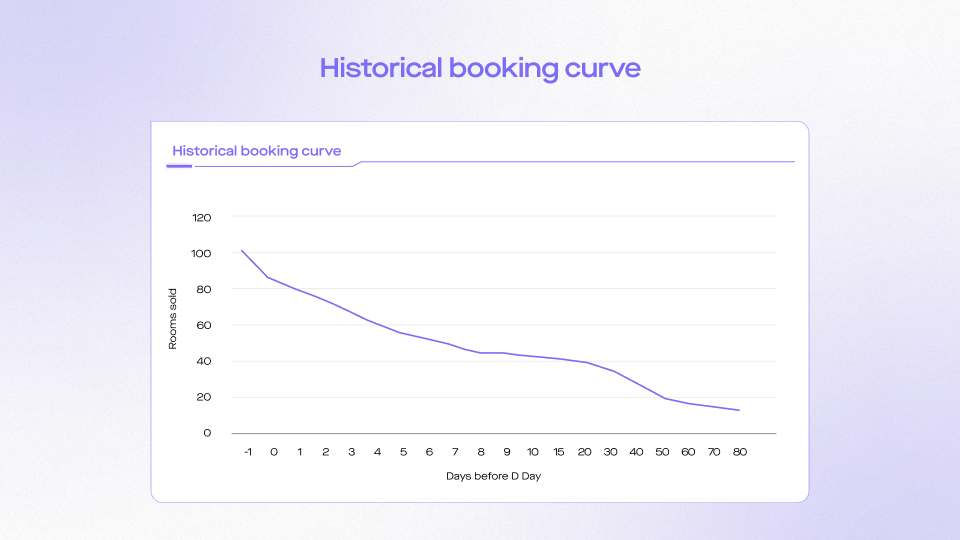
Why does this matter?
Because OTAs reward listings that convert consistently. A property that regularly turns impressions into bookings sends a positive signal to the algorithm. A listing that receives views but rarely converts slowly loses visibility.
This sometimes creates uncomfortable decisions. Accepting a slightly lower early booking may improve booking pace and ranking, which can unlock higher-paying bookings later in the season.
Dennis illustrated this with a real example. In a 120-unit complex, some owners pushed for higher minimum rates. When a $95 minimum was enforced, complaints stopped. But benchmarking showed that units without that minimum generated $1,000 to $2,000 more revenue over three months because they secured bookings earlier at lower rates and benefited from stronger overall performance.
The lesson is not to discount indiscriminately. It is to understand that short-term ADR protection can sometimes harm long-term ranking and revenue.
Property managers must educate owners that revenue management decisions are portfolio strategies, not emotional reactions to individual reservations.
Aim for a heartbeat pattern in your ranking
A healthy booking pace creates a healthy ranking pattern.
Think of your ranking like a heartbeat. It should move. There should be natural ups and downs. If your listing stays at the very top for too long, it often means you are underpriced and over-converting. You may be filling too quickly and leaving revenue on the table.
On the other hand, consistently ranking too low means you are not generating enough booking momentum. Visibility drops, conversion slows, and you start relying on reactive price cuts instead of strategic positioning.
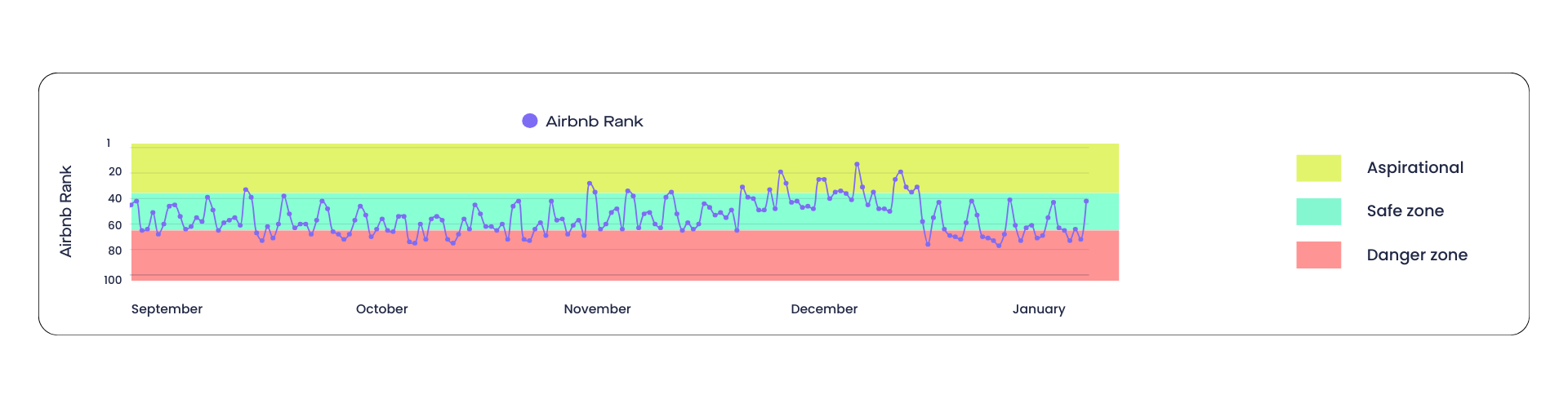
The goal is not to sit permanently at the top. The goal is controlled fluctuation within a strong visibility window.
When ranking rises, you optimize yield. When it softens slightly, you stimulate demand. This steady rhythm, visibility, conversion, yield, creates sustainable revenue performance.
If your ranking is flatlining at the top or stuck at the bottom, something in your system needs adjustment. Healthy revenue management is not about extremes. It is about maintaining a strong, dynamic equilibrium.
Revenue management has become a specialized discipline
Dennis realized that managing this complexity internally was no longer the most efficient path. Instead of having his team spend hours each day troubleshooting distribution issues and adjusting listings, Casiola partnered with AutoRank.
By shifting the operational burden to a team fully dedicated to revenue optimization, they improved performance while freeing internal resources to focus on growth.
Because today, access to tools is not the advantage. Everyone has tools. The advantage comes from expertise, focus, and system-level execution.
If you want to scale your portfolio and maximize profitability, revenue management must be treated as a strategic discipline, not an operational afterthought.
AI will increase productivity, not replace strategy
AI is rapidly reshaping how revenue teams operate.
Bart-Jan pointed out that AI allows revenue managers to oversee far more units than before, dramatically increasing productivity.
Routine monitoring, pattern detection and micro-adjustments can increasingly be automated.
But strategy remains human.
AI can adjust prices. It cannot decide your brand positioning. It cannot negotiate owner expectations. It cannot define risk tolerance. It cannot determine expansion strategy.
The implication is clear: the future revenue team is smaller, more strategic and more system-focused. Operational pricing work will shrink. Oversight, communication and cross-functional alignment will grow in importance.
Conclusion: Revenue growth starts with visibility, not just pricing
Revenue management today is no longer just about adjusting prices. It’s about understanding how visible you are, how well your listings convert, how strong your reviews are, and how effectively your distribution supports your strategy.
If pricing changes aren’t delivering the results you expect, the issue may not be your rates, it may be your ranking.
The first step to improving performance is clarity.
We’ll analyze your current OTA visibility and show you where you stand in your market and where revenue opportunities may be hiding.