

%20(1).jpg)
Distribution Management
Distribution management is the operational layer of revenue management focused on managing a listing’s position—its rank—across platforms like Airbnb, Vrbo, and Booking.com. Ranking is a foundational input to revenue management because it is a leading indicator of booking probability, changing before impressions, page views, and bookings.
Used alongside dynamic pricing, distribution management helps property managers maximize revenue by actively influencing visibility and competitiveness rather than reacting after performance declines.
AutoRank’s Distribution Management solution gives revenue teams the structure, insights and expertise to turn ranking signals into clear actionable decisions. The result: faster reactions, better pricing decisions, and higher revenue outcomes.
AutoRank delivers this through:
- A proven ranking methodology that serves as a leading indicator of booking probability
- An executive dashboard that highlights listings requiring attention, allowing teams to manage by exception.
- Real-time competitor insights that enable proactive adjustments before performance is impacted
- Ranking-driven owner conversations, providing clear, forward-looking context to manage owner discussions and drive mutual decisions.
- Airbnb listing optimization aligned with guest search behavior, seasonality, and Airbnb’s SEO logic
- Advisory services that tailor AutoRank’s proprietary methodology to your specific market and embed it into your team.
AutoRank has developed this solution over the past 4 years through primary research and validated by AutoRank´s revenue management team which delivered higher revenue and profitability in A/B tests with in-house revenue management teams.
What Is “Ranking” and why it matters
Airbnb’s search algorithm is designed to maximize bookings. Your property´s position on an Airbnb search (ie rank) is therefore a dynamic signal that continuously adjusts based on how likely your property is to convert a search into a confirmed reservation.
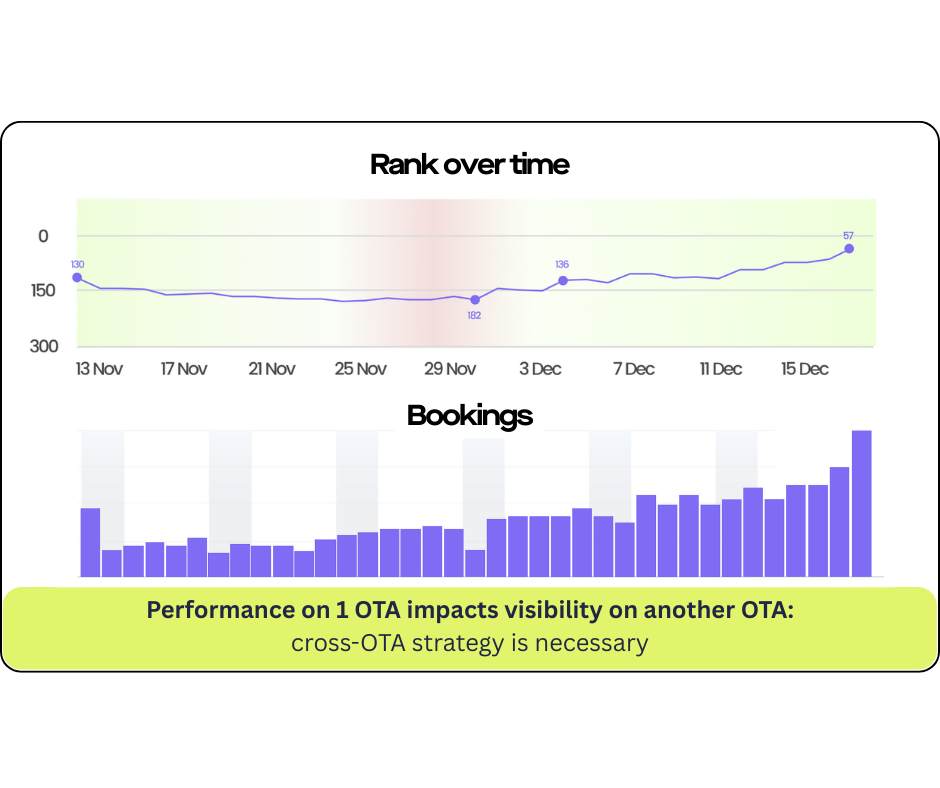
This is why ranking is not static. A listing does not “have” a rank, it earns a position continuously. Analysis of thousands of Airbnb searches reveals a clear pattern: ranking changes appear before changes in impressions, page views, and bookings.
Ranking Is a forward-looking signal, not a result
For property managers, this makes ranking a leading indicator of performance shifts. Changes in rank typically appear before declines in views, occupancy, or revenue, providing valuable lead time to respond.
Ranking does not guarantee bookings. Instead, it signals booking probability—how likely your listing is to convert relative to competitors under current conditions. As illustrated in the graphs below, ranking is a leading indicator of bookings:
Without understanding where your property ranks in relation to demand, pricing, and competition, revenue decisions become sub-optimal..
Distribution Management matters even more in 2026 as occupancy levels are expected to decline by 2%. Distribution management—actively engineering visibility— becomes a key differentiator between average and top-performing portfolios.
What actually drives Airbnb ranking?
Based on AutoRank’s primary research, Airbnb ranking is most influenced by:
- Reviews
- Pricing and perceived value
- Competitive set dynamics
- Listing optimization
- Availability
- Restrictions and policies
- Booking pace
- Quality signals (host responsiveness, listing accuracy, guest experience)
- OTA programs and designations (Guest Favorite, Superhost, Genius, and similar)
While these factors exist across all major OTAs, their impact varies significantly by platform and market. Also,, these factors do not operate independently. For example, Airbnb evaluates how they interact together to determine whether showing a listing increases the probability of a booking. AutoRank quantifies how each variable is weighted depending on OTA and market characteristics, allowing revenue teams to focus on the levers that matter most
Take cancellation policies as an example. More restrictive policies generally reduce ranking—but the key question is how much they matter relative to pricing, availability, or competitor policies. Answering that requires a quantitative approach.
With quantitative insight,, revenue managers move beyond guesswork and make precise, data-driven decisions that directly impact performance.
What ranking really represents for revenue managers
Ranking is not just a number—it is decision-driven data.
- It is a leading indicator of booking probability
- It reflects real-time changes in competitor actions
- it provides feedback on the impact of specific actions
- It supports clearer, forward looking data for owner communications
Over time, teams learn how much to adjust and which levers to pull, to deliberately engineer ranking instead of reacting to drops after the fact.
Because ranking requires context to interpret correctly, AutoRank pairs its data with distribution management expertise, adapting the methodology to each market and embedding that knowledge directly into revenue teams.
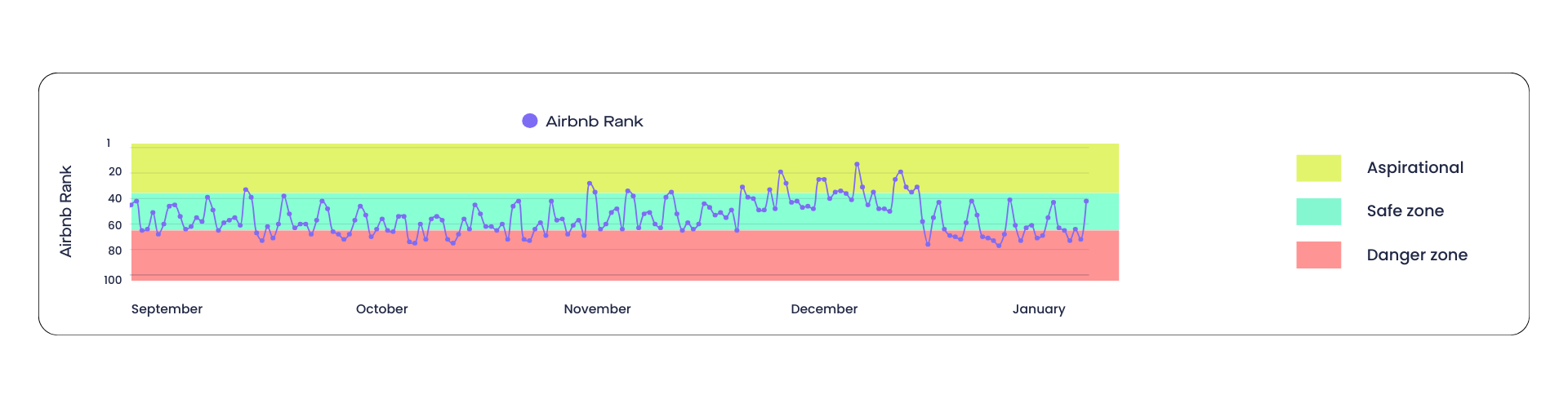
When ranking improves consistently, it signals a strengthening competitive position. This often allows teams to hold rates, maintain restrictions, or increase ADR without sacrificing bookings.
When ranking deteriorates, it acts as an early warning, prompting adjustments before visibility and revenue decline.
Think of ranking like a heartbeat: monitored continuously, acted on only when it moves outside expected patterns.
Practical examples: How ranking responds to change
Ranking responds multiple signals simultaneously. The examples below show how early action can improve performance before bookings are materially affected.
Example 1: Review impact and short-term recovery
Reviews are among the strongest signals in Airbnb’s ranking algorithm, especially when recent.
In one case, a property received a one-star review and dropped from page two to page ten within days, sharply reducing visibility. To recover ranking, the base price was temporarily reduced by approximately 20%.
The review remained, but competitiveness improved. Ranking recovered while new positive signals accumulated.
.png)
Key takeaway: Key takeaway: Negative reviews can cause sudden ranking drops, but their impact can often be mitigated quickly through short-term adjustments — not long-term discounting.
Example 2: Competitive pricing shifts
In early November, several competitors lowered prices. As relative competitiveness declined, the property’s ranking gradually dropped.
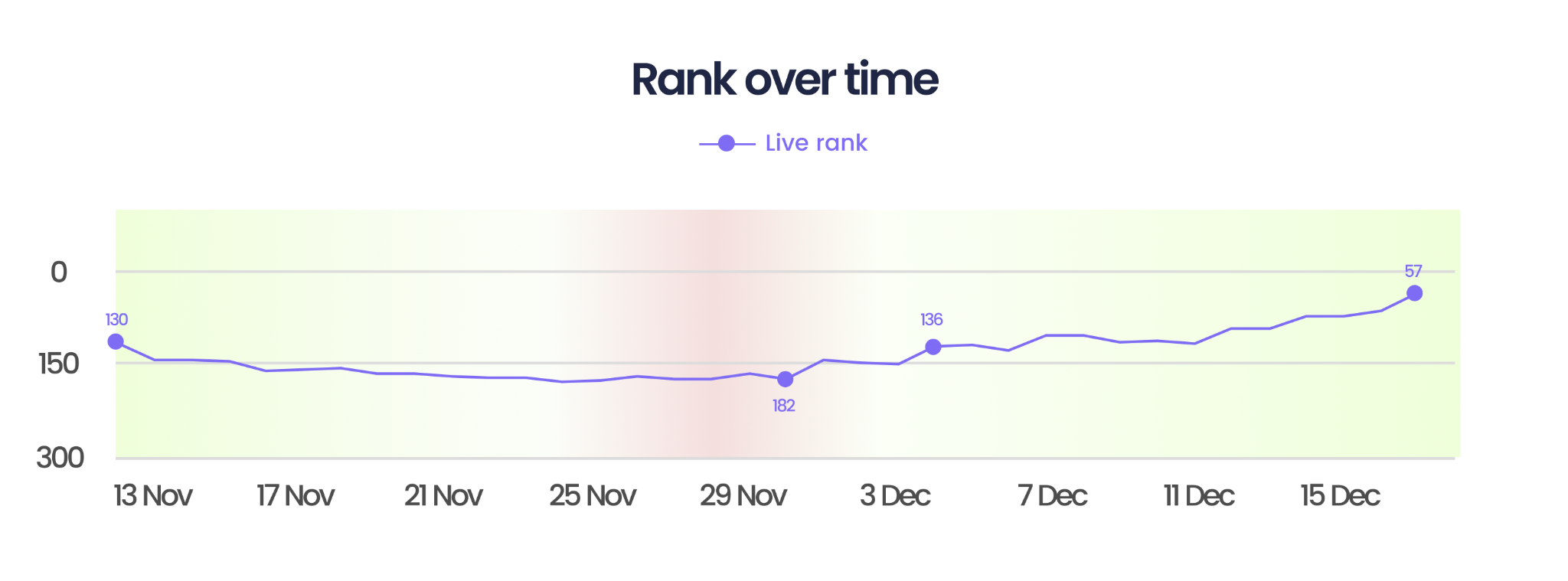
To reverse the trend:
- Pricing was recalibrated
- Cancellation policies were made more flexible
- A limited promotion was applied
Ranking improved, followed by higher impressions, page views, and bookings.
Key takeaway: Ranking is relative. Even in stable demand environments, competitor behavior can materially affect ranking. Monitoring rank enables earlier, more controlled responses.
Implementing distribution management in practice
Distribution management is essential to modern revenue strategy. Think of it like Formula 1 race: the pricing engine is the car, the revenue manager is the driver, and distribution management is the pit crew. Ranking doesn’t drive the car—but it determines how well it performs.
When ranking improves steadily, it indicates rising booking probability—often allowing teams to maintain rates or tighten policies without immediate downside. Likewise, the opposite holds true. When ranking deteriorates , it acts as an early warning - prompting adjustments before visibility and revenue decline.
Ranking refines how much to act and which lever to pull. Minor dips may require small adjustments, while sustained declines signal misalignment in pricing, policies, or availability.. Importantly, price is not always the fastest or best fix—flexibility or promotions often restore visibility as or more efficiently.
Without ranking, revenue decisions are reactive. With ranking, teams anticipate change and act deliberately—before performance deteriorates.
What comes next
This article sets the foundation for the concept of ‘rank’. In the next blogs, we’ll go deeper into the factors that influence ranking and how they interact. Pricing. Reviews. Flexibility. And, most importantly, how to interpret ranking correctly without overreacting.
Ranking is powerful, but you can’t use it without training.
That is why we are also launching a webinar series where Jarne Vancompernolle will go deeper into the practical benefits of using rank in your strategy. Register now to get ahead of the future of revenue management.