

The 2026 World Cup will trigger the biggest travel surge North America has seen in the past 10 years, but it hasn’t started yet. Across the U.S., Canada, and Mexico, occupancy is still in single digits because fans are waiting for the December 5 match schedule and hotels are holding back inventory. This isn’t weak demand; it’s delayed demand and it gives property managers a rare window to get ahead while the market is calm and OTA algorithms are easy to influence.
A huge, but unpredictable opportunity
World Cup tourism does not behave like normal tourism. Forecasting becomes almost impossible because the usual signals, seasonality, weather, holidays, don’t matter. Fans book around match clarity, not traditional travel patterns. Until the fixtures are announced, they don’t know which cities to stay in, how long they’ll stay, or when they’ll move.
This creates a volatile, match-dependent booking curve. Cities hosting popular teams like Brazil, Mexico, Argentina, England, or Germany may fill 30–40% faster than markets hosting less-followed teams. Knockout rounds will trigger rapid last-minute spikes as teams advance. A single goal can literally shift thousands of fans from one city to another.
We can already see significant spikes in future prices during the World Cup, which reflects the uncertainty among property managers

What impact can properties outside of the host-cities expect?
World Cup tourism will not stay confined to match cities. It will spread across the continent as visitors seize the opportunity to combine football with broader travel. For property managers, this means one thing: relying on last year’s pricing patterns is not an option. The markets that prepare early, with dynamic and forward-looking strategies, will capture the highest share of this unpredictable but massive opportunity.
How World Cup travel behavior works
The World Cup introduces behavioral patterns that don’t exist in normal travel cycles. Below we mention major factors that impact the behavior of World Cup fans, that can help you prepare for the wave of demand coming your way.
Visa and FIFA PASS policies expand travel across North America
The U.S. government’s decision to give FIFA PASS ticket holders priority visa interviews signals more than streamlined travel logistics, it indicates that the U.S. is preparing for World Cup tourism on the scale of 2022, when demand far exceeds supply.
By accelerating visa approvals for millions of international fans, the U.S. is essentially clearing the runway for what it believes will be the largest inbound travel wave of the decade.
This policy opens the door to massive international movement across all three host countries. Canada and Mexico will benefit as fans use cross-border stopovers and regional flights, turning the World Cup into a full North American itinerary. A fan landing in Vancouver may spend days in Whistler or Calgary before heading to Seattle; travelers entering Mexico might add stops in Monterrey, Baja, or Puerto Vallarta; U.S. visitors may anchor trips around Denver, Austin, Orlando, or Phoenix before moving to their match cities.
The intention behind these visa policies is clear: maximize the flow of global travelers and unlock the full economic potential of the event. For property managers, this means the opportunity stretches far beyond the stadium cities. The World Cup won’t create isolated demand spikes, it will create a continent-wide travel wave.
Fan mobility will be match-driven and unpredictable
Fans follow their teams, and teams move. This means demand is not defined by geography but by match outcomes.
The graph below shows that forward bookings rise and fall in sharp waves around match dates. Instead of a smooth climb toward the event period, you see sudden peaks, steep dips, and inconsistent pacing. Some match weeks already show noticeable uplifts while the days around them remain nearly empty.
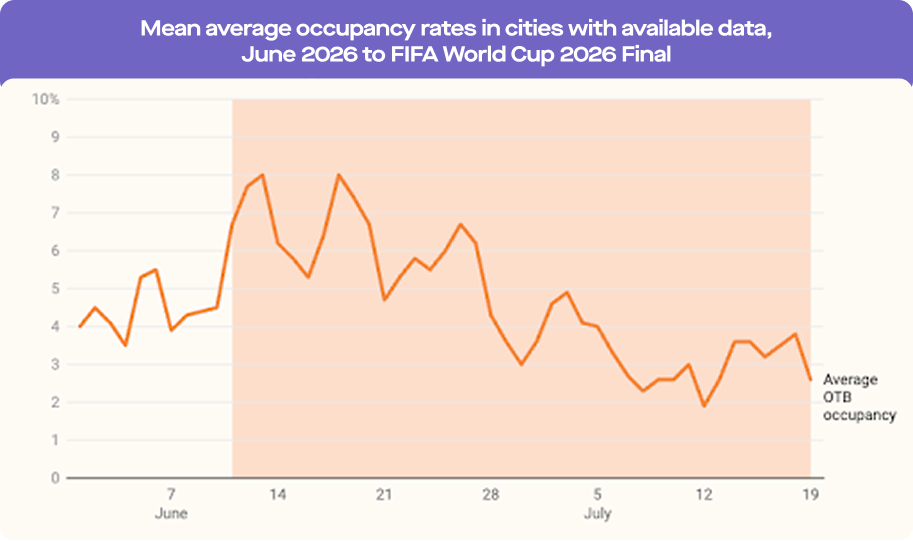
This curve confirms three facts:
- Bookings will not come gradually, they will come in bursts. Fans book when information becomes available: ticket announcements, group draws, knockout results.
- Certain dates become compressed instantly. The peaks in the curve show how quickly demand surges even without the final fixtures.
- Most markets are not yet active. The deep dips across June and July indicate how much opportunity remains for STRs to rise in OTA rankings before the wave hits.
Knockout rounds will intensify this. Popular teams create instant compression. A strong performance from Mexico, the U.S., Canada, Brazil, or Argentina will push thousands of fans into whichever city hosts their next match. Property managers in cities like Houston, Atlanta, Vancouver, Guadalajara, and Miami should expect unpredictable, last-minute surges.
Prepare for European demand
World Cup travel isn’t only coming from within the U.S., European visitors will represent a major share of incoming demand. But Europeans don’t book or evaluate accommodations the same way American guests do, so property managers need to adjust both their offering and their channel strategy.
European travelers place higher value on functional, comfort-oriented amenities such as kettles, quality coffee setups, blackout curtains, reliable heating and cooling, and well-equipped kitchens. They also have different expectations around cleanliness standards, bedding quality, and bathroom practicality. Small details that Americans may overlook can be deal-breakers for European guests.
Just as important: many European visitors don’t search first on Airbnb. Their default OTA is often Booking.com, which is deeply embedded in European travel culture and widely trusted. This means property managers focusing solely on Airbnb risk missing a large portion of inbound European demand.
To capture this segment effectively, listings must be optimized both in terms of amenities and channel visibility. Offering the right setup and appearing where Europeans actually search will be crucial to converting this audience during the World Cup surge.
Revenue strategies property managers need to capture World Cup demand
Property managers need to raise rates at the right moments, respond to demand shifts in real time, and avoid locking in low-value bookings before the market peaks. The goal isn’t early occupancy, it's optimized revenue.
Prepare dynamic pricing strategies before December 5
Once fans know where their teams will play, there is no time for manual adjustments. So your revenue management strategy should be set by then. In our previous webinar we talked about the best tactics to implement for the World Cup demand in more detail.
Once fans know where their teams will play, bookings will begin immediately and there won’t be time for manual pricing adjustments. Your revenue strategy needs to be in place before December 5 so you can react instantly when the schedule drops. We explored these tactics in our previous webinar, but the principle is simple: the match draw activates the market.
The World Cup will not behave like a normal tourism season. Host cities will see sharp, unpredictable swings based on match popularity, team performance, and rapid movement across cities. But just as important and often overlooked, is that World Cup demand will spread far beyond host cities.
Fans will anchor their trips around matches but will spend most of their time exploring major U.S. hotspots and national parks: places like NYC, LA, Miami, Chicago, Las Vegas, Denver, San Francisco, the Grand Canyon, Yosemite, Yellowstone, Banff, Vancouver Island, and other high-demand destinations.
Many travelers will treat the tournament as a once-in-a-lifetime North American vacation. That means non-host markets may fill earlier—and more steadily—than host cities themselves.
A phased approach makes this manageable:
Phase 1: Now → December 5, 2025
Build your foundation. Update amenities, refresh listing content, and ensure you’re connected to every OTA your audience uses.
Know your guests. European travelers, who represent a huge share of inbound demand, have different expectations than U.S. guests. They value transit access, walkability, efficient amenities, and flexible check-in far more than Americans. They also search primarily on Booking.com, not Airbnb, making visibility on this channel essential.
For non-host cities, this phase is critical. Travelers planning “World Cup + vacation” trips will start browsing long before December 5. These guests are looking for bucket-list destinations and national parks, not just match locations. Building visibility now puts your listings in front of them early.
Phase 2: December 5 → March 2026
Move fast. Adjust pricing within hours of the draw, update titles and keywords to reflect team placements, and shorten LOS to capture early bookers. Agility matters most in host cities, where occupancy can shift overnight.
But outside host cities, the strategy changes. These markets will experience different but equally powerful demand patterns:
- Fans will book vacation-heavy destinations earlier than host cities.
- Many will create multi-city or multi-country routes, combining parks, beaches, and major metros with match days.
- Popular tourist regions will see steady, early compression as Europeans lock in long trips.
In these cities, pricing should still react quickly, but with consistent, measured adjustments. Instead of sharp increases tied to match draws, focus on pacing data and your competitive set. Your main goal is converting long-lead European travelers who are building extended itineraries.
Phase 3: April → June 2026
Stay agile. Track pickup daily, push upsells, fine-tune cancellation policies, and keep your OTA rankings strong with regular listing updates.
For non-host cities, this is when the real uptick begins. As host cities begin to compress, travelers widen their search radius and book nearby or completely unrelated destinations—including nature trips, entertainment hubs, and iconic cities. Europeans especially will fill early inventory in these spots.
To stay competitive:
- Monitor availability in your broader region, not only your city.
- Watch your OTA ranking closely, spillover markets get crowded fast.
- Keep flexible LOS and cancellation terms in place, as these travelers plan longer, exploratory routes.
Putting this structure in place ensures you’re ready not just for match-driven demand in host cities, but also for the huge wave of visitors treating the World Cup as a North American adventure, exploring major cities, national parks, and iconic destinations across the U.S., Canada, and Mexico.
Strengthen OTA visibility for international travelers
The higher you appear in OTA search results, the more likely you are to get booked and the more confidently you can price. In the U.S., most travelers start on Airbnb, but European visitors rely heavily on Booking.com. With a huge wave of Europeans coming for the World Cup, showing up high on Booking.com will matter just as much as performing well on Airbnb.
So how do you get in front of those early bookers? Each platform rewards different things. Airbnb responds well to SEO-friendly descriptions, so make sure your listing includes clear references to stadiums, transit lines, neighborhoods, and anything that helps a guest understand location and convenience at a glance.
Booking.com, on the other hand, leans more on pricing and flexibility. Listings with competitive rates, shorter minimum stays, and guest-friendly cancellation terms tend to rise in the rankings. It’s less about keywords and more about being easy to book.
When you tailor your approach to each platform, you give yourself the best chance of getting seen early, before the real surge hits.
Offer flexibility
World Cup travelers move fast and change plans often. To capture them, your policies and pricing need to adapt just as quickly.
Booking windows will be extremely short
Guests will book close to arrival, creating rapid turnovers and more gaps than usual. Use this to your advantage by adjusting cleaning fees, applying gap-night pricing, and offering add-ons like early check-in, late checkout, or transport options to increase revenue during these quick cycles.
Use hybrid cancellation policies
A balanced approach works best. Keep strict, non-refundable terms on key match days where demand is guaranteed. Between games, offer more flexible options to attract travelers moving between cities. This setup protects high-demand nights while keeping conversion strong during transitional periods.
Flexibility drives early conversions
Before match details are finalized, early planners, families, media teams, sponsors, and international travelers prioritize adaptable stays. Shorter minimum nights and clear cancellation options make your listing more appealing to them and help secure bookings ahead of the surge.
Early performance boosts OTA ranking
The bookings you win now elevate your position in OTA search results. Strong early performance builds momentum, making your listing more visible when demand peaks. During an event this competitive, that visibility advantage is one of the most valuable assets you can create.
Your best next step forward
The calm on your dashboards is misleading. Property managers are holding back inventory, fans are waiting for the match schedule, and once the December 5 fixtures drop, demand will surge across North America, not just in host cities, but in major metros, resort markets, and national park destinations.
Those who prepare now will capture the earliest and most valuable bookings. Strengthening OTA visibility, adjusting stay rules, and setting dynamic pricing in advance will put you ahead before hotels release inventory and competitors react.
AutoRank helps you do exactly that.
Our revenue management service combines smart pricing, listing optimization, and real-time market insights to keep your properties competitive through every demand spike. Whether you’re in a host city or a non-host hotspot, we help you rank higher, price smarter, and convert faster.
Book a demo with AutoRank and get ahead of the surge, before the market wakes up.